The Tropalect Deck · Practical uses
Put the patterns
to work.
A deck for examining change—not just drawing a card. Compare directions, question a plan, and explore what a workable next movement could require.
Watch five demonstrations in 3 minutes 24 seconds · Watch seven animated exercises.
No purchase is needed to try these examples. Use the free pattern reference or handbook alongside a notebook.
Artwork and card wording are unchanged.
01Name a situation.One project or shared process. One time window.
02Work with the cards.Compare, arrange, or question a possible movement.
03Return to what happens.Choose an observation or small test and a review point.
01 · Compare possibilities
Different starting points.
Different routes.
You know the kind of change you need. Which route fits what is actually happening now?
You are developing a workshop and want fresh possibilities. Should you develop one central idea, bring people into contact, extend an existing format, or connect resources in a new way?
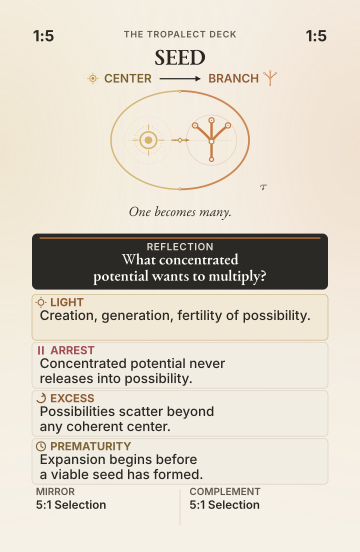
Lay out Seed 1:5, Cross-Pollination 3:5, Growth 4:5, and Emergence 6:5. Each arrives at Branch, but from a different Origin. Compare the starting conditions before deciding which question is useful. You can explore all seven destinations below.
What kind of movement are you exploring?
Open a destination to compare its seven possible starting points. These are reference entries, not additional cards or prescribed steps.
Find coherenceCenter · A priority, a shared purpose, or a clearer organizing idea.
Unity maintaining unity.
Difference returns to a deeper unity.
Relationship reveals or produces unity.
Structure resolves into a coherent essence or identity.
Many possibilities resolve toward one center.
Many coordinated parts become one coherent whole.
Transformation creates a new center.
Make a distinctionDivide · A usable difference, separation, or differentiation of roles.
Unity becomes distinction.
Polarity encounters and reinforces itself.
Relationship exposes distinctions that isolation concealed.
Stable form separates.
Possibilities separate into increasingly distinct paths.
An integrated whole differentiates necessary roles.
Completion generates a new distinction or question.
Open an exchangeRelate · Contact, dialogue, experimentation, or feedback.
A center discovers itself through relation.
Difference becomes communicative relationship.
Relationship amplifies relationship.
Structure develops an opening through which relation can occur.
Possibilities interact experimentally.
A connected system begins communicating with itself.
Transformation becomes relationship.
Give it durable shapeForm · A workable agreement, boundary, routine, or project.
Potential becomes form.
Difference becomes structure.
Relationship becomes durable form.
Structure reinforces structure.
One of several possibilities takes durable form.
Cooperation becomes durable structure.
Transformation becomes durable form.
Open possibilitiesBranch · Different ways something new could become possible.
One becomes many.
A distinction opens multiple futures.
Contact generates new possibilities.
Structure extends into new possibilities.
Branching generates further branching.
An integrated system generates possibilities unavailable to isolated parts.
Completion reopens possibility.
Bring parts into coordinationConverge · Exchanges and dependencies that help distinct parts work together.
A coherent center gathers a field around itself.
Distinct elements integrate without becoming identical.
Relationships become a networked whole.
Structures integrate into larger structures.
Diversity becomes interdependent.
Integration reinforces integration.
The transformed part returns to the larger whole.
Explore completion or renewalReturn · An ending or transformation, with attention to what must be carried forward.
Identity releases its current form into transformation.
A polarity reaches transformation or inversion.
Encounter changes the participants in lasting ways.
Form yields to transformation.
Excess possibility is transformed through subtraction.
Integration crosses a threshold into a qualitatively new order.
Transformation itself becomes recursive.
Name what you already have: a concentrated idea, an exchange, an established form, or coordinated parts. Choose one feasible way to explore new possibilities from that starting point.
A genuinely different possibility—not just another name for an existing option. Note what became possible and which conditions supported it. A desired destination does not prove a transition has begun.
Explore the Echo Finder Book pp. 150–156; link opens the PDF.
02 · Examine a proposed change
Before committing,
ask four kinds of question.
What would a constructive version look like? Where might it stall, become excessive, or be forced too soon?
A group enjoys informal creative conversations and is considering a recurring meetup. They want a dependable rhythm without turning the connection into an obligation nobody can sustain.
Consider Covenant 3:4: Relate → Form. Its core meaning is “Relationship becomes durable form.” The Light and Shadow phrases below are the card’s exact wording; the questions beneath them apply that wording to this example.
Light
Commitment, agreement, protocol, ritual, dependable reciprocity.
Try asking: What dependable rhythm could serve the group?
Arrest
Relationship never becomes reliable practice or agreement.
Try asking: What could prevent the conversations from becoming a reliable arrangement?
Excess
Rules replace the living relationship they should serve.
Try asking: Could the rules take over from the connection they are meant to support?
Prematurity
Commitment hardens before reciprocity has matured.
Try asking: Have people had enough experience together to agree to this commitment?
Discuss the four questions, then agree only to a small, revisable experiment that the participants freely accept. Identify what time, capacity, and support it would require.
Did the arrangement actually become dependable? Did it serve the participants, or create an unwanted burden? Review both whether the change happened and whether it was constructive. This is reflective inquiry, not a formal risk assessment.
Read Covenant and its three Shadow tests Book pp. 19, 63–64; link opens the PDF.
03 · From intention to practice
Chosen is not
yet concrete.
You have plenty of ideas. What is missing: a priority, a workable form, or both?
Several promising projects compete for your attention. New plans keep appearing, but none receives sustained work.
A possible connected sequence is Selection → Incarnation. A direct move from possibilities into a resourced project may instead be Commitment 5:4. The starting conditions and observation window decide which description fits; do not count one episode twice.
Choose one idea for a seven-day trial. Reserve a realistic work period and specify one small output.
Did one project receive sustained attention? Was the work period used, and did it produce the intended output? An unused schedule does not demonstrate a completed transition. The cards do not choose the project for you.
Read “Choosing Is Not Yet Committing” Book pp. 142; link opens the PDF.
04 · Examine a repeating process
Map the loop.
Explore the missing exit.
More activity is not always a different movement. What keeps recurring—and what never gets a chance to happen?
A project group generates ideas, tries experiments, discovers more ideas, and returns to another brainstorming session. The activity continues, but nothing reaches a usable form.
This is the book’s Novelty Loop, not a verdict that exploration is wrong. One physical Proliferation 5:5 card can mark the beginning and the return; no duplicate card is needed. Only call it an observed loop when the events support that sequence.
Write the actual events beside the cards. Explore a possible exit: Selection 5:1, Commitment 5:4, or Pruning 5:7. What makes that movement unavailable? Consider resources, responsibilities, and incentives as well as individual choices.
Did the proposed change create a different result, or did the same sequence resume? Test one existing proposal before adding new ones, when that is feasible. If the pattern does not fit, revise or leave the reading open.
Explore chains and the Novelty Loop Book pp. 139, 158; link opens the PDF.
05 · Compare the reverse direction
Another rule—or
a better opening?
The same two activities can move in opposite directions. That difference changes the question.
Covenant 3:4
Relate → Form
A volunteer group has useful conversations, but agreements are unreliable. What exchange needs a dependable arrangement?
Interface 4:3
Form → Relate
A volunteer group has established procedures, but no workable way to raise concerns. Where does the structure need a deliberate opening?
These are Mirror cards. Compare them side by side rather than assuming that either is automatically the remedy or the next step.
Describe which difficulty is present. Consider one freely agreed responsibility, or one bounded feedback channel, depending on what the situation supports.
Did an exchange become more dependable—or did relevant information gain a reliable way through? Keep necessary protections and a way to revise the arrangement.
Explore Interface and its Mirror Book pp. 63–64, 76–77; link opens the PDF.
06 · Carry learning forward
A lesson can become
more than a memory.
What deserves a place in how you work next time?
After a community event, the organizers realize that everyone assumed someone else was handling setup. They can explain what happened, but have not changed how they prepare.
Explore Tradition 7:4: Return → Form. Here, Tradition is not about following a rule simply because it is old. It asks whether learning from transformation deserves durable expression.
Choose one lesson worth preserving. Design a small practice around it—for example, a setup checklist with an agreed coordinator. Record why the practice exists and how it can be revised.
At the next event, did the practice preserve the useful lesson? Keep the principle alive instead of maintaining a rule whose purpose has been forgotten.
Read Tradition and its practice Book pp. 123–124; link opens the PDF.
Go further
Four more ways
to work with change.
Use these for a specific shared process or project. Participation is optional, and nobody’s inner life is yours to interpret.
Turn a discussion into a usable agreement
Two collaborators disagree about responsibilities. Compare Dialogue 2:3 with Covenant 3:4: understanding one another is different from establishing a dependable arrangement.
Try it: First summarize each concern accurately. Then record what both people freely agree to do and when to review it. Treat Dialogue → Covenant as an observed chain only when the exchange actually leads to the agreement.
Look for: Compare agreed responsibilities with what each person actually did. Silence, pressure, or exhaustion is not consent.
Read “Difference Becomes Agreement” Book pp. 143; link opens the PDF.
Find the level where change is needed
Teams are asked to cooperate but rewarded for protecting their own output. A reading focused only on personal attitude would miss the surrounding arrangement.
Try it: Examine routines within teams, exchanges between them, and coordination across the organization. Foundation 4:4 may describe observed routines; Interface 4:3 and Architecture 4:6 may be proposed responses, not completed transitions.
Look for: Does a feasible exchange point improve coordination, or do incentives still discourage it? Keep authority, resources, and constraints visible.
Read “A Team and Its Surroundings” Book pp. 138, 144; link opens the PDF.
Notice when one part outpaces another
A maker develops more product lines while fulfillment still uses arrangements designed for a much smaller operation. Describe product development and fulfillment separately rather than assigning one card to everything.
Try it: Compare what has changed, what remains stable, and what still assumes the old conditions. Different parts can occupy different Echoes. The book calls differing rates of transition Phase Lag.
Look for: Which dependency needs attention? Strengthening support, improving coordination, or slowing expansion may be worth exploring. A difference in phase is not automatically a problem.
Read about Phase Lag and Polyphase Book pp. 137; link opens the PDF.
Review a project from seven angles
A workshop has a clear purpose and many activity ideas, but feedback, maintenance, and completion have not been discussed.
Try it: Use the seven-card Spiral to examine Center, Divide, Relate, Form, Branch, Converge, and Return as seven question positions. Consider purpose, distinctions, exchange, structure, possibilities, coordination, and completion. Any Echo may occupy any position.
Look for: One consequential unanswered question and one observable test. These are not seven mandatory stages or automatically a connected chain.
Read the Seven-Card Spiral Book pp. 135; link opens the PDF.
Begin with one real situation
The next step is
a better question.
Try one example with the free handbook or pattern reference. A physical deck makes the same movements tangible: lay them out, compare them, and return to what you can observe.
The book and handbook remain free without signup. Physical-deck interest is non-binding; no payment is collected.
Tropalect is a contemporary symbolic framework for reflection and creative inquiry—not prediction, diagnosis, or a substitute for qualified advice. Keep decisions with the people involved. Read the guidance on consent and accountability.
Back to the beginning ↑