1
Center
Gather around what is essential. Establish coherence and orientation.
Gather · cohereA symbolic language of change
Tropalect is a symbolic language for recognizing recurring patterns of change. Use it for reflection, journaling, and creative inquiry—how things form, divide, relate, return, and become.
Both PDFs are free. No account or email required.
Watch the 3-minute demonstration
Prefer a physical deck? Join the preorder list
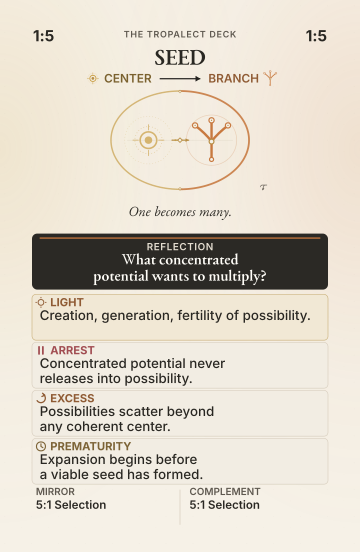
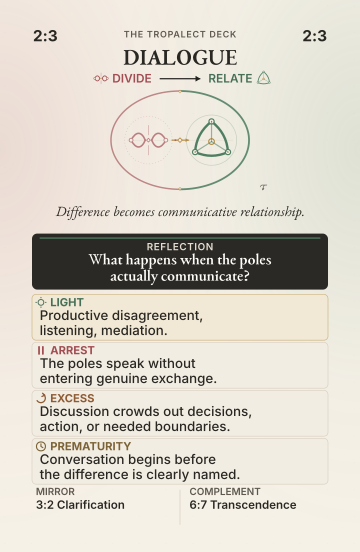
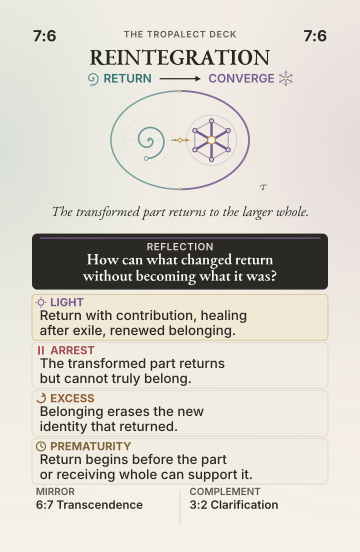
One language, three companions
A Practical Guide to Reading Change. Learn the method, try a reading, and look up all 49 Echoes.
Free PDF · full referenceThe foundational book: the grammar, extended readings, worked cases, and limits of interpretation.
Physical deck · preorder interest49 Patterns of Becoming. The same coordinates, meanings, and questions in a tactile format.
The essential distinction
“Nothing merely is. Everything is becoming. Meaning lies in the shape of the becoming.”
Most symbolic systems begin by asking what something is. Tropalect begins with a different question: what kind of transition is taking place?
A disagreement can become dialogue. Many possibilities can become one choice. A stable form can open into growth. Very different events can share the same relational pattern.
The seven Primes
Primes describe activities, not personalities or ranks. Their numbers are stable labels. The sequence is an organizing vocabulary—not stages every situation must follow.
Gather around what is essential. Establish coherence and orientation.
Gather · cohereDistinguish, separate, contrast, and create a meaningful boundary.
Separate · clarifyMeet, exchange, communicate, and enter responsive contact.
Meet · exchangeStabilize, embody, contain, and give a pattern durable structure.
Stabilize · embodyMultiply, explore, differentiate, and open new possibility.
Explore · multiplyIntegrate, coordinate, weave, and become a larger living whole.
Integrate · weaveComplete, release, transform, and begin again carrying a trace.
Complete · renewA disciplined reflection practice
An Echo is a prompt, not a verdict. The method brings symbolic insight back into contact with observable evidence.
Choose one focal system and one time window: a project over the past week, rather than your whole life.
Write what was happening and what is becoming different. Begin with ordinary observations, not a hoped-for card.
Choose deliberately to test an observed pattern, or draw to invite an unfamiliar question. Neither supplies evidence by itself.
Read the path, core meaning, and reflection question, then examine Light, Arrest, Excess, and Prematurity. Shadow is never a verdict about a person.
Keep one close alternative. Name an observable sign, a small action or observation, and a reason to reconsider. A no-fit reading is allowed.
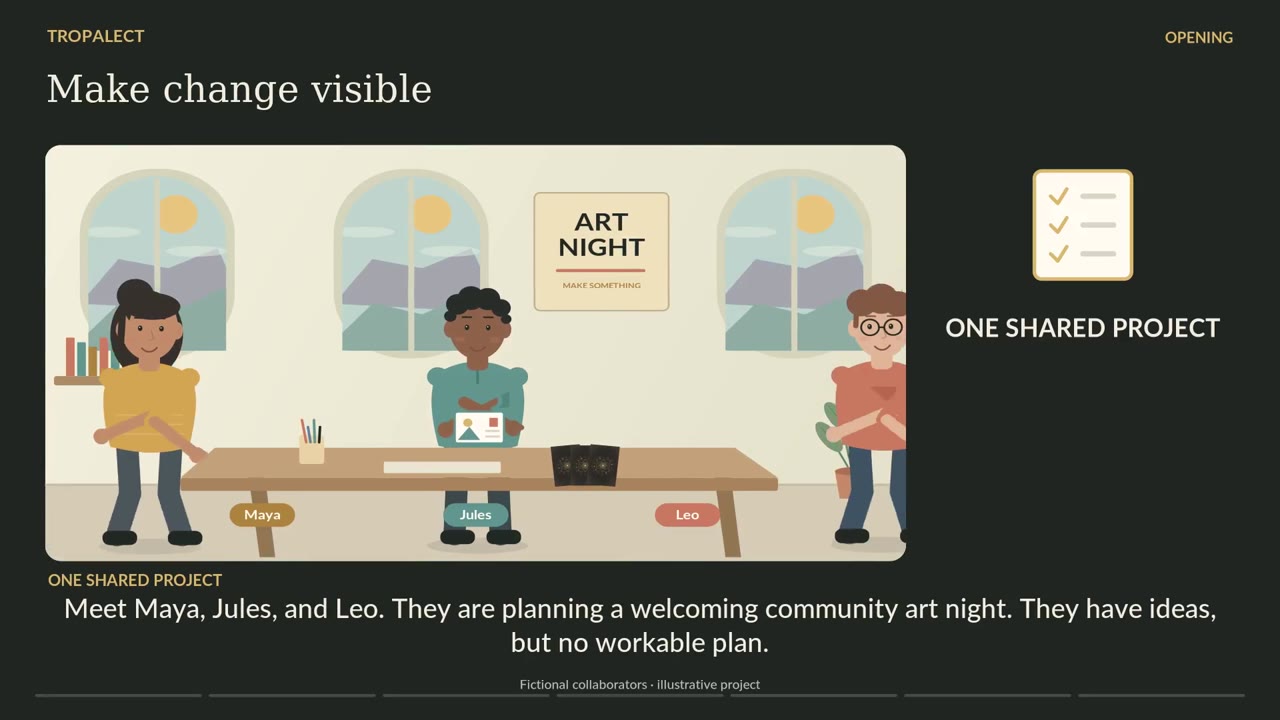
Follow a community art-night project through seven ways to arrange, compare, and work with the cards.
8 minutes 19 seconds · narrated · English captions
Watch the deck in action · 3:24
Compare possible routes. Examine a plan. See what the cards can bring to a real situation.
The deck in practice
Compare possible directions. Examine what may be missing. Explore the conditions a change would need—and how you would recognize it happening.
You know the kind of change you need. Explore different ways of getting there.
Try this use 02 · START HEREUse Light and the three Shadows to question what a proposed change would require.
Try this useDistinguish choosing a direction from giving it a workable form.
Map a repeating process and examine which possible exit is missing.
Compare making an exchange dependable with making room for it to happen.
Give something learned a useful place in what happens next.
A Practical Guide to Reading Change
The compact way into the language. Learn the seven Primes, read the direction of a card, and bring the question back to a real situation.
32-page PDF · 607 KB · no email or purchase required.
The foundational book · Free PDF
The complete reference for the same language used in the handbook and deck—not a separate system.
Explore the grammar, all 49 extended Echo readings, the current v6 meanings and questions, Light and the three Shadow modes, Mirror and Complement, scale, Trace, Threshold, and practical ways to test a reading. Worked cases make the distinctions concrete; an index and reference tables help you browse.
Expanded First Edition · 175-page PDF · 1.96 MB · no email or purchase required.
The Tropalect Deck
A contemplative 49-card system for recognizing the structure and direction of change. The same Echo coordinates connect each physical card to its handbook and book entries.
Explore The Tropalect Deck and how to use it →
Preorder the DeckEvery coordinate has a shared meaning
| From / to | 1Center | 2Divide | 3Relate | 4Form | 5Branch | 6Converge | 7Return |
|---|---|---|---|---|---|---|---|
| 1 Center | 1:1 | 1:2 | 1:3 | 1:4 | 1:5 | 1:6 | 1:7 |
| 2 Divide | 2:1 | 2:2 | 2:3 | 2:4 | 2:5 | 2:6 | 2:7 |
| 3 Relate | 3:1 | 3:2 | 3:3 | 3:4 | 3:5 | 3:6 | 3:7 |
| 4 Form | 4:1 | 4:2 | 4:3 | 4:4 | 4:5 | 4:6 | 4:7 |
| 5 Branch | 5:1 | 5:2 | 5:3 | 5:4 | 5:5 | 5:6 | 5:7 |
| 6 Converge | 6:1 | 6:2 | 6:3 | 6:4 | 6:5 | 6:6 | 6:7 |
| 7 Return | 7:1 | 7:2 | 7:3 | 7:4 | 7:5 | 7:6 | 7:7 |
This is an index, not card artwork. Select a coordinate to read its exact name, meaning, question, Light, and Shadows.
Open the searchable reference →First Edition reservation
Join the no-charge preorder-interest list for The Tropalect Deck. Final price, production details, and an estimated shipping window will be shared before you decide whether to buy.
The physical prototype must pass readability, color, trim, and handling checks before a commercial promise is responsible.
No payment is collected. The digital book and handbook are already free above. Joining this list does not guarantee stock or a shipping date.